Stephen Paxton

Stephen Paxton (born in Durham, 27 December 1734; died in London, 18 August 1787) was an 18th-century cellist and composer. He is remembered along with his brother, William Paxton (1737–1781), for the composition of numerous pieces for the cello, most notably glees. Due to imprecise attribution methods of the time, the works of the two brothers are often confused or improperly attributed. Paxton won London Catch Club prize medals for his glees How Sweet, How Fresh (1779), Round the Hapless (1781), Ye Muses Inspire Me (1783), and Blest Pow'r Here See (1784). Paxton is listed as one of the lost graves to eminent persons on the Burdett-Coutts Memorial in Old St. Pancras Churchyard in London.
Cello vol.1 - 2024-06-28T00:00:00.000000Z

The Golden Age - 2024-06-28T00:00:00.000000Z

Cello Exam Pieces from 2024, ABRSM Grade 3 - 2023-06-08T00:00:00.000000Z

Have Cellos, Will Travel - 2022-09-16T00:00:00.000000Z

The Golden Age of the Cello in Britain - 2022-03-04T00:00:00.000000Z

Jane Austen Collection (Music from the Austen Family Collection Performed on Historic Instruments) - 2013-04-01T00:00:00.000000Z

Six Sonatas for Bassoon and Harp, Op. 3 - 1970-01-01T00:00:00.000000Z

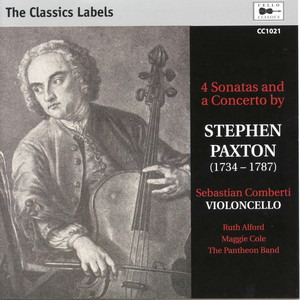
Paxton: Cello Sonatas & Concerto - 2009-03-02T00:00:00.000000Z

Similar Artists

Guillaume Rebinguet-Sudre

Giuseppe Maria Jacchini

Baltic Baroque

Antonio Montanari

Giovanni Battista Cirri

Orfei Farnesiani

Andrea Caporale

Francesco Ferrarini

Catherine Jones

Callipygian Players

Giacobbe Basevi Cervetto

Giovanni Stefano Carbonelli

Alessandro Ciccolini

Giacomo Facco

Giovanni Battista Somis

Judit Foldes

Jacob Klein

Martin Berteau

Mauro D'Alay

Jean-Pierre Guignon